

News
Yagi–Uda Dipole Antenna Design
By
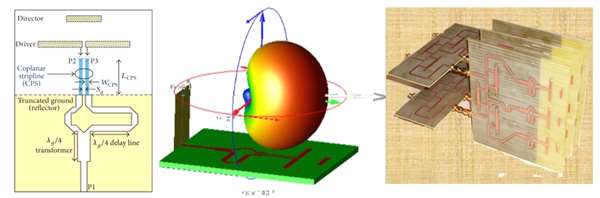
Yagi-Uda dipole (also called quasi Yagi-Uda) antenna has broadband compared to most of the planar arrays like microstrip patch antennas are typically narrow-band and have relatively low efficiency due to an undesired substrate mode excited if high dielectric-constant substrates are used.quasi-uda-antenna-anil-pandeyThe designed quasi-Yagi antenna has several advantages over more traditional wire antennas radiating in free space. Wire-type antennas in free space are extremely fragile at high frequencies and difficult to feed. Also, conventional Yagi antenna provides a unidirectional radiation pattern but is not preferred for wideband applications. The main application of interest for this antenna is on sensor nodes comprising a wireless sensor network inside a multipath rich environment such as an aircraft fuselage. In practice, these antennas would be mounted atop the metal package of a sensor node and used to communicate preferentially toward the front or rear of the aircraft.The layout design of the uniplanar quasi-Yagi antenna is shown here. The antenna is fabricated on a 0.254 mm thick Duroid substrate with metallization on both sides. The yagi-uda-design-anil-pandeytop metallization consists of a microstrip feed, a broad-band microstrip-to-coplanar stripline (CPS) balun and two dipole elements, one of which is the driver element fed by the CPS and the second dipole being the parasitic director. The metallization on the bottom plane is a truncated microstrip ground, which serves as the reflector element for the antenna. The parasitic director element on the top plane simultaneously directs the antenna propagation toward the end-fire direction and acts as an impedance-matching parasitic element. One of the most unique and effective features of this antenna is the use of the truncated ground plane as the reflector element. The driven printed dipole is used to generate a surface wave.The FEM (Finite element method) simulation results of the return loss of the antenna are shown here. The simulated bandwidth (VSWR < 2) are 40 %. To my knowledge, no uniplanar antenna has ever achieved such a wide instantaneous bandwidth with such a compact design.The radiation patterns are measured across the VSWR < 2:1 bandwidth. Antenna radiation patterns at 10 GHz is shown here. Across the entire bandwidth, the gain is better than 5.6 dB.https://srventechconsultancy.com/2018/01/06/yagi-uda-dipole-antenna-design/
Comments